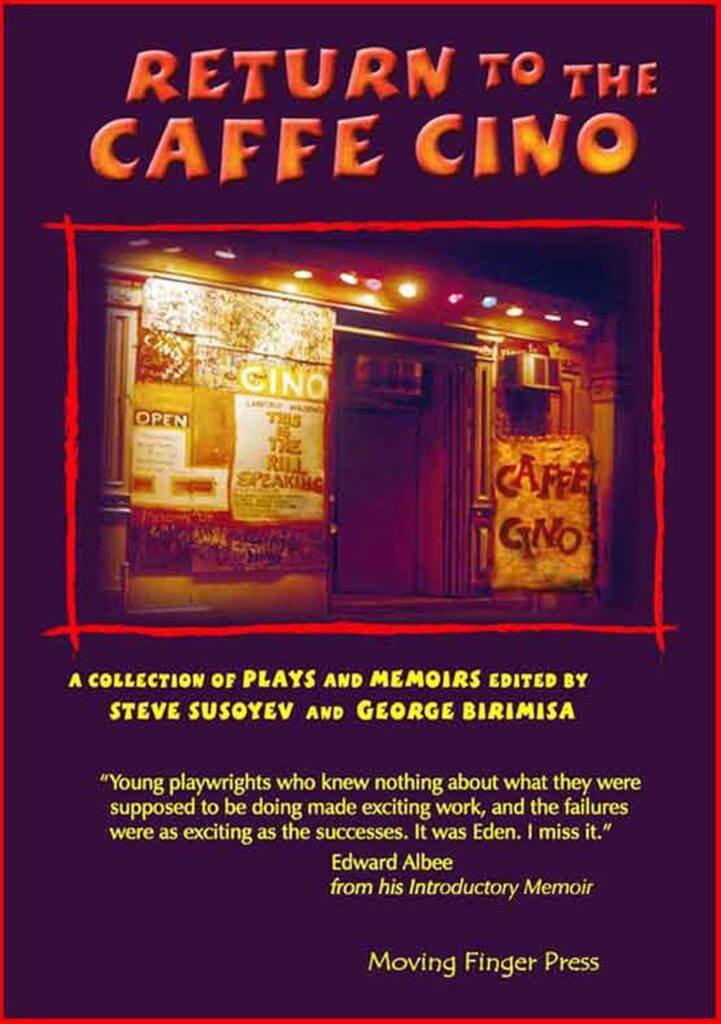
The following contains excerpts, used with special permission, from:
“In his work Koutoukas frequently turns to traditional, classical structures for his experimentation: ‘But if you want to get wild or campy, you need the strength of the Classical structure. Then your teapots can have nervous breakdowns.’ As David Hirsch explains, Koutoukas merges the classical and romantic. ‘Classical structure becomes a common device supporting the weight of a Romantic inflection which is meant to bring down the stars. The Romantic and Classical are united by sexual longing at its most campy” (Stone 85).

“Noted for his wild, campy style, his surreal, existential worlds, his highly poetic language, Koutoukas writes in a variety of styles, from the poetic… to the slightly more prosaic… from the outrageous camp… to the gentle sentimentality…. Characteristics of his plays is the creation of a bizarre, inscrutable world in which characters attempt to construct or determine some meaning, both for the world at large and for their own lives in particular. His works are often less concerned with the interaction of characters than with one or few characters’ search for meaning and meaningfulness” (Stone 83-84).
Photo Credit: Victor Carnuccio - Artflux Productions Ltd.
“It is the skirting of meaning, the presentation of an indecipherable, paradoxical universe that so frequently leads to the linking of madness with Koutoukas’s work: Robert Heidi says, ‘His plays came out of an internal, psychic madness. It is as if he did not always know what he wrote-the plays came out of a dreamscape”; similarly, John Gruen wrote in Vogue in 1969, ‘Koutoukas dwells on fantasy and madness, stretching reality toward points of no return” (Stone 87).
“Michael Smith summarizes Koutoukas’s style as, … flamboyantly romantic, idiosyncratic, sometimes self-satirizing, full of private references and inside jokes, precious, boldly aphoristic, and disdainful of restrictions of sense, taste, or fashion. Koutoukas is perhaps the last of the aesthetes. Underlying the decoration, his characteristic themes concern people or creatures who have become so strange that they have lost touch with ordinary life, yet their feelings are all the more tender and vulnerable-the deformed, the demented, the rejected, the perverse” (Stone 86).

Photo Credit: The Peter Hujar Archive / Artists Rights Society (ARS).

“Koutoukas creates in his plays an absurdist world devoid of meaning but always on the verge of meaning, a nonsense realm threatening to achieve but never achieving clarity…. This world, in which basic signifying systems are sabotaged and understanding is always deferred, reflects the existentialist’s understanding of existence. Philosopher Abraham Kaplan explains… ‘For today large parts of the earth’s population feel that they are confronted with a world they never made, a world too vast and complex to yield to human urging, and one which is indifferent-if not down-right hostile-to human aspiration” (Stone 87).
Photo Credit: James D. Gossage - LaMaMa Archive
“Though many of the Cino playwrights and directors used camp in their productions, Koutoukas is the artist most closely associated with the style. His work is characterized by the use of glitter, cross-dressing, and outrageous styles…. For gay men, camp was a means of covert communication and of publicly acknowledging their sexuality without the risk of an overt statement” (Stone 85).
“At about the same time that Koutoukas’s first play, Only a Countess May Dance When She’s Crazy, was being performed (December 1964), Susan Sontag published her “Notes on Camp” in the fall of 1964 issue of Partisan Review. She defines camp as “love of the unnatural; of artifice and exaggeration. And camp is esoteric-something of a private code, a badge of identity even, among small urban cliques” (Stone 85).

Photo Credit: Lynn Gilbert

“As a protégé of avant-garde filmmaker and performance artist Jack Smith, Koutoukas was influenced by works such as Flaming Creatures and by Smith’s interest in actress Maria Montez. Though many critics spoke of Montez’s limitations as a performer, Smith was fascinated by her. In “The Perfect Filmic Appositeness of Maria Montez,” he wrote, “M.M. dreamed she as effective, imagined she acted, cared for nothing but her fantasy (she attracted the fantasy movies to herself-that needed her- they would have been ridiculous with any other actress-any other human being). Those who credit dreams became her fans” (Stone 87).
Hoberman, J. On Jack Smith’s ‘Flaming Creatures’ (And Other Secret-Flix of Cinemaroc). New York, Granary Books, 2001 More here
“Cobra Woman (1944), in which Montez appeared, proved particularly fertile ground for Koutoukas’s imagination, so much so that references to cobra jewels appear in many of his works. Sometime after the demise of the Cino, he appeared in a work written specifically for him by Harvey Fierstein and entitled, In Search of the Cobra Jewels” (Stone 87).


“Among the most frequently discussed of Koutoukas’s works is Medea or Maybe the Stars May Understand or Veiled Strangeness, a work influenced by a news story about a young woman in Harlem who killed her child. In quick succession, Medea premiered at La Mama, only days later opened at the Cino, and subsequently played at Theatre Genesis. At Theatre Genesis, Medea was played by a woman; at La Mama and Caffe Cino, under the direction of Koutoukas, the role was played by the bearded Charles Stanley probably best known for his pioneering work with Deborah Lee and Yvonne Rainer in postmodern dance” (Stone 88).
Photo Credit: James D. Gossage - LaMaMa Archive
“While Koutoukas’s Cino plays have no explicitly gay characters, they constantly challenge and transgress gender codes. Koutoukas was fascinated by the classical practice of men playing women’s roles. Thus his work often was written with the intent of being played by either a man or a woman…” (Stone 87).

Photo Credit: Conrad Ward - Caffe Cino Pictures
“[In Medea]…Koutoukas mingles the common with the exalted, the mundane with the sublime, the comedic with the tragic. In her fury Medea dashes bleach in Jason’s face and kills their child by throwing him into a washing machine (not forgetting, of course, to include an appropriate measure of Oxydol detergent). In his review for the Village Voice, Michael Smith describes the play as being: ‘so eccentric as to be nearly unthinkable. The play is a straightforward enactment of the final terrible scene when Medea murders her child to avenge herself on Jason. The language is high-flown as befits a tragedy, the tragic impulse is pursued without deviation, and Koutoukas has injected a philosophical content of evident seriousness-the play is violently anti-logic, anti-Greek. Medea is the very heroine of old-fanatical, hideously wronged, ecstatically suffering.” (Stone 88).
“When Stanley performed as Medea, he did so with a full beard and with no effort to pass as a woman. Koutoukas suggests that Medea emerges from a position of rage, pain, and marginalization so great that she is outside or beyond terms such as gender and sex, that her emotions are so overwhelming as to defy containment within such traditional constructs. In his review Smith noted that ‘Charles Stanley is a grotesque Medea, in not quite the same way that Medea was a grotesque woman, but as the play goes on he becomes invidiously convincing.’ … ‘Linda Eskenas plays Medea more naturally, with less madness and ecstasy than did Charles Stanley…. One is more able to see the real woman inside this monster of suffering and vengeance, which is valuable. But the monster is diminished in the process, the mythical grandeur yields to comprehension, and the performance fails to accumulate the headlong force the play requires.’ The actual presence of a woman’s body, then, makes the performance too real, too understandable, too recognizable” (Stone 89).

“It was a position of absolute marginalization that intrigued Koutoukas and became central to many of his plays. Most of his characters are outrageous and bizarre. To be ordinary or mundane in Koutoukas’s world is the great tragedy” (Stone 89).
Photo Credit: Robert Patrick - Caffe Cino Pictures: Posters and Flyers, H.M. Koutoukas’ Only a Countess May Dance When She’s Crazy (1964).
“…Koutoukas spoke of his start as a playwright: ‘I was going to kill myself but I decided to write a play instead so that I could leave something behind that I had made with my bare hands…. Then I forgot to kill myself” (Stone 84).
“…he said that all of his ‘things are shredded’ after performance. According to his friend and fellow playwright Robert Heide, Koutoukas has always hesitated to publish his works because he wrote for a specific moment and does not wish to allow publication to freeze them in time or to remove them from the context for which they were written” (Stone 84).
“[Robert Patrick on H.M.] One who extended the bounds of dramatic imagination, and without whose exuberant example the world would never have been ready for Harvey Fierstein or Charles Busch or The Rocky Horror Picture Show, was H.M. Koutoukas, who I consider our finest playwright since Tennessee Williams” (Stone 184).
***************************
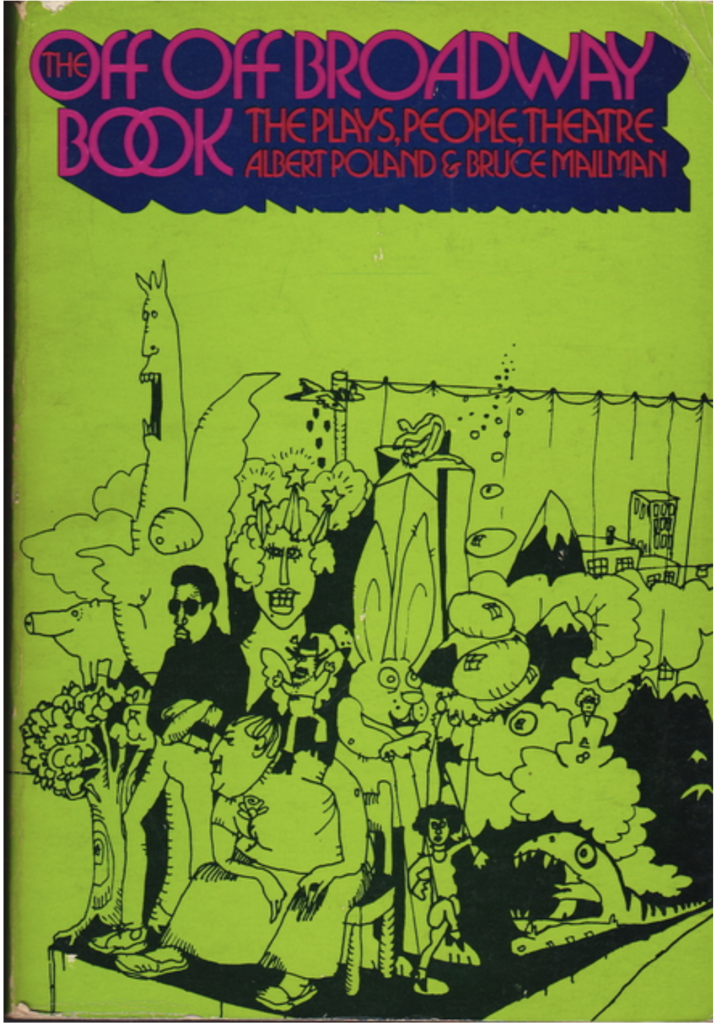
For further research into the work of H.M. Koutoukas & the history of Coffeehouse & Off-Off Broadway Theatre, the following resources are INVALUABLE & the essential starting point.....